Open a pack. See what you actually pulled.
TCG Pack Opener is a browser-based Pokémon pack opening simulator for people who enjoy the ritual of opening a booster pack without spending money. The demo focuses on Scarlet & Violet—Prismatic Evolutions, a 180-card set built around Eevee and its evolutions.
Click Open this pack to pull ten cards. Five are common, three are uncommon, one is the reverse-holo slot, and one is a rare-or-better slot. Each card is dealt from its real rarity pool, so the result uses actual card names, numbers, and artwork rather than made-up filler.
What the pull rates mean
The rarity model is a community estimate derived from TCGplayer's historical pull-rate research, which covered more than 1,200 packs when the original model was assembled. It measures how often each rarity tends to appear in a pack. It is not an official Pokémon Company odds sheet, and it does not give an exact card-by-card probability for every one of the 180 cards.
That distinction matters. A reverse-holo slot can produce a common, an uncommon, or even a rare card. The final rare slot can be a regular Rare, a Double Rare, an Ultra Rare, a Special Illustration Rare, or a Hyper Rare. The simulator keeps those slots separate instead of flattening the whole pack into one misleading rarity percentage.
Your collection stays on this device
Every card you pull is counted in a local collection. You can leave the page, open another pack later, and continue from the same browser. The collection is stored in localStorage, not tied to an account, and it is not a financial portfolio or a substitute for owning a physical card.
The completion meter counts unique cards pulled from the 180-card set. Because the rarer tiers are intentionally uncommon, early packs will fill the common and uncommon portion quickly while the special-art chase cards remain visible goals.
Why Prismatic Evolutions?
Prismatic Evolutions is an unusually focused set: the Eeveelutions form its visual center, but it also includes trainers, Ogerpon masks, Paldea Pokémon, and a wide range of illustration styles. That gives the simulator enough visual variety to make each ten-card spread feel different.
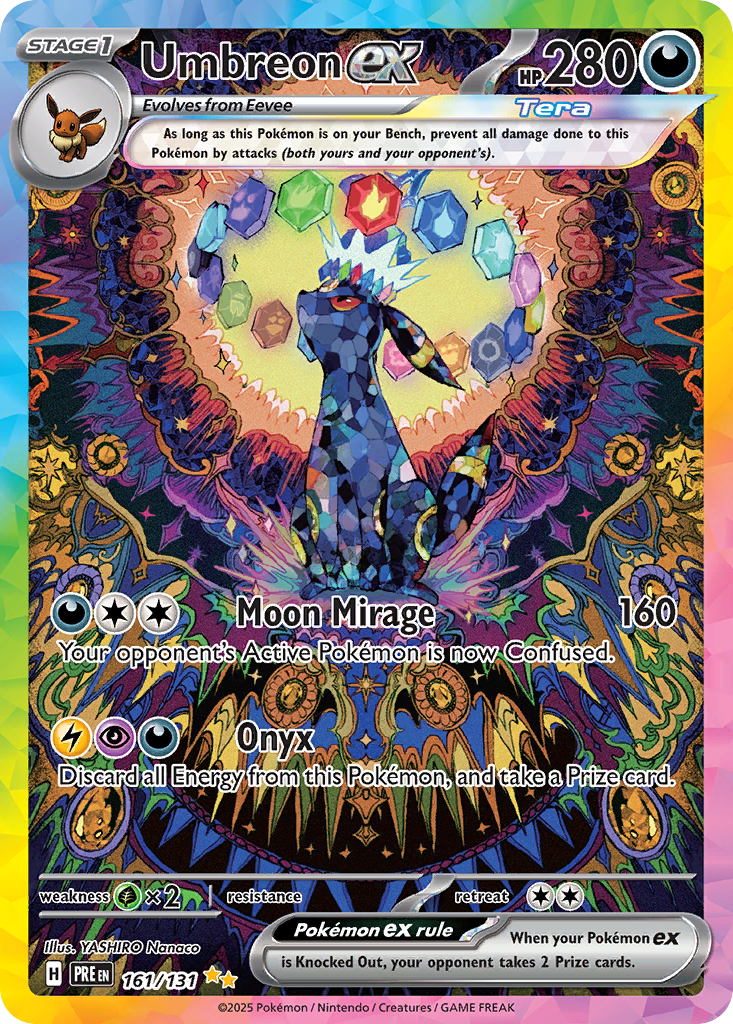
The chase cards in this demo include the Umbreon ex, Eevee ex, Espeon ex, Sylveon ex, and other Special Illustration Rare cards from the set. They appear at the same rarity tier in the model; no individual card is artificially boosted to make the demo feel more generous.
A fair pack-opening ritual
The simulator does not sell packs, does not require a sign-in, and does not represent the cards as real-world assets. It is a free fan-made practice tool for understanding set composition and pull-rate language. The card images are the official images exposed by the Pokémon TCG data project, and the set logo belongs to The Pokémon Company.
Use it to compare how a ten-card pack is structured, see the difference between reverse holo and rare-or-better slots, and keep a personal record of the cards you encounter. If you are buying physical packs, use the pull-rate table as context, not as a promise about any particular sealed product.


Pull notes 0